

Assessing the effect of forest management on above-ground carbon stock by remote sensing

Drone (picture by Rajesh Balouria via Pixabay)
This study examined how forest management affects carbon storage in forests of the Brabantse Wouden National Park in Belgium. By comparing carefully matched managed and unmanaged forest sites, researchers found that unmanaged forests stored significantly more carbon above ground, mainly because they contained fewer but larger trees. The study also tested whether satellite data could accurately estimate forest carbon stocks. Combining different satellite sources improved carbon estimates compared to using optical imagery alone. However, satellite-based models were unable to detect the carbon stock differences observed in the field between managed and unmanaged forests. The results highlight both the value and current limitations of remote sensing for forest carbon monitoring and underline the continued importance of field measurements for assessing management impacts.
Forests play an important role in helping to tackle climate change by storing carbon in trees and vegetation. Understanding how different management approaches influence this carbon storage is essential for developing effective forest policies and practices.
This study examined forests in the Brabantse Wouden National Park in Belgium to compare carbon storage in managed and unmanaged forests. Researchers selected forest sites that were similar in terms of soil, climate, tree species, and landscape conditions, allowing them to focus specifically on the effect of management.
Field measurements showed that unmanaged forests stored significantly more carbon above ground than managed forests. While managed forests often contained more trees, these tended to be smaller. Unmanaged forests generally had fewer but larger trees, resulting in higher overall carbon stocks.
The study also explored whether satellite data could be used to estimate forest carbon stocks accurately and detect differences between managed and unmanaged forests. Researchers combined information from different satellite systems that capture forest health, vegetation characteristics, and forest structure.
The results showed that combining multiple satellite data sources improved carbon stock estimates compared to using optical satellite imagery alone. However, despite these improvements, the satellite-based models were not able to reliably detect the carbon differences observed in the field between managed and unmanaged forests.
Several factors may explain this limitation. Dense forests with high carbon stocks can be difficult for satellites to measure accurately, leading to underestimation. In addition, the available field data used to train the models were relatively limited, increasing uncertainty in the results.
The findings highlight both the potential and the current limitations of satellite monitoring for forest carbon assessment. While remote sensing can support large-scale carbon monitoring, field measurements remain essential for detecting more subtle differences related to forest management. The study also suggests that protecting and allowing forests to develop naturally can contribute to higher carbon storage, while further advances in monitoring technologies are needed to improve large-scale assessments.
Media
-
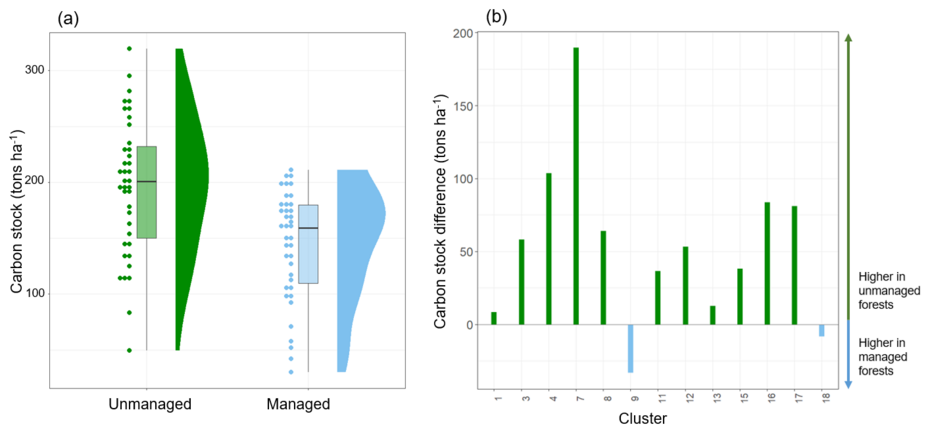
Results of the carbon stock analysis comparing managed and unmanaged forests in the field plots
- Monitoring & Projecting
- Landowners & Practitioners
- Planners & Implementers
- Policy Actors
- Climate change mitigation
- Natural processes and ecosystem preservation
- Belgium