

Comparing the Index of Biodiversity Potential (IBP) in managed and unmanaged temperate lowland forests

Brabant forest
What makes a forest truly rich in biodiversity? Is it simply the number of trees, or the hidden structures that develop over decades – ancient trees, decaying wood, and the small habitats that support countless species? This study was conducted in Brabantse Wouden National Park in Belgium and explores how the Index of Biodiversity Potential (IBP) can help answer this question by comparing mature managed forests with forests where management has been stopped.
The results reveal a clear pattern: as forests are left to develop naturally, their biodiversity potential increases. The biggest changes come from the gradual accumulation of deadwood, very large trees and tree-related microhabitats, which provide essential resources for fungi, insects, birds and many other forest organisms.
But the study also shows that biodiversity and forest management are not opposites. Even managed forests can become more valuable for nature by protecting old trees, retaining deadwood and encouraging structural diversity.
The research confirms that the IBP is a powerful practical tool for guiding biodiversity-friendly forestry. However, mature forests can exceed the current scoring limits, meaning their ecological richness may be underestimated. Refining the index could help reveal the full value of Europe’s most biodiverse forests – and support better decisions for the forests of the future.
As biodiversity becomes a central goal of modern forest management, there is a growing need for practical tools that allow forest managers to evaluate the ecological value of forests and identify opportunities for improvement.
One such tool is the Index of Biodiversity Potential (IBP). Developed in France and now adapted for several European regions, the IBP provides a rapid and cost-effective way to assess how well a forest stand can support biodiversity. Rather than measuring individual species directly, the index focuses on structural features of forests that are strongly linked to biodiversity, such as deadwood, old trees, habitat structures and tree species diversity.
The new study, “Comparing the Index of Biodiversity Potential (IBP) in managed and unmanaged temperate lowland forests”, investigates whether the IBP can detect differences between close-to-nature managed forests and forests where management has been stopped for several decades. The research was conducted in the Brabantse Wouden National Park in Belgium, where researchers compared 42 mature forest patches under different management histories.
Measuring the biodiversity potential of forests
The IBP is based on ten ecological criteria that describe the capacity of forests to provide habitats for a wide range of organisms, including plants, fungi and animals. These criteria include native tree species richness, vertical forest structure, standing and lying deadwood, very large trees, habitat trees, canopy openness, forest continuity, wet habitats and rocky features.
The strength of the IBP lies in its simplicity. Forest managers can collect the required information relatively quickly without carrying out complex biodiversity surveys. The index is not intended to predict the exact number of species present in a forest, but rather to indicate whether a forest contains the structures and conditions that biodiversity depends on.
The researchers applied the Benelux version of the IBP in mature lowland forests, comparing actively managed stands with forests that had been set aside between 1984 and 2010. These forests were already relatively close to nature, meaning the study examined subtle differences rather than extreme contrasts between intensively managed plantations and untouched old-growth forests.
Biodiversity increases when forests are allowed to develop naturally
The results show that the IBP successfully distinguished between management regimes. In most forest types, biodiversity potential increased with the time since management stopped. The main drivers behind this increase were the development of features associated with forest maturity:
1) more deadwood, both standing and lying;
2) a greater number of very large trees;
3) an increase in tree-related microhabitats, such as rot holes and other structures used by specialised species.
These features are particularly important because many forest organisms depend on habitat conditions that develop only over long periods. Fungi, insects, lichens, birds and other species often require old trees, decaying wood or specific microhabitats that are rare in regularly harvested forests.
The study also showed differences between forest types. Pine-dominated forests generally had lower IBP scores than broadleaved forests, reflecting their historical management as more simplified stands with lower structural diversity. Oak forests tended to have higher biodiversity potential than beech forests, partly because oak trees often provide more diverse microhabitats through their rough bark and greater capacity to host lichens, mosses and other organisms.
Managed forests can also support biodiversity
Although unmanaged forests generally scored higher, the study does not suggest that biodiversity conservation requires abandoning forest management everywhere. Instead, it highlights opportunities for biodiversity-friendly management.
Even relatively extensively managed forests often lacked large deadwood pieces and old habitat trees. By deliberately retaining older trees, protecting trees with microhabitats, increasing deadwood availability and promoting structural diversity, managers can significantly improve biodiversity potential within working forests.
This is particularly relevant in Europe, where we need forests to provide multiple benefits: timber production, climate regulation, recreation, biodiversity conservation and habitat protection. The challenge is not simply choosing between management and non-management, but finding approaches that integrate ecological functions into multifunctional forests.
Improving the IBP for mature forests
While the study confirms that the IBP is a valuable tool, it also identifies limitations. The current “capped” IBP assigns maximum scores once certain thresholds are reached. In mature, highly developed forests, these thresholds are often exceeded, especially for deadwood, large trees and microhabitats.
As a result, the current system may underestimate the differences between exceptionally rich forests and moderately diverse forests. A forest with twice as much deadwood or many more habitat trees may receive the same score once the maximum threshold has been reached.
The authors suggest several possible solutions: introducing additional scoring levels, adjusting thresholds for mature forests or using an uncapped version of the IBP that records the full range of values. Such improvements could increase the sensitivity of the tool while maintaining its practical usefulness.
A practical tool for future forest management
The study demonstrates that the IBP is a valuable framework for understanding how management influences forest biodiversity potential. It is particularly useful for identifying areas where biodiversity can be enhanced and for evaluating changes after management interventions or forest protection measures.
However, the IBP should not replace detailed biodiversity monitoring, the authors argue. Changes in species communities often occur slowly and require complementary methods. Instead, the IBP should be seen as a practical decision-support tool that helps managers recognize and maintain the ecological structures that biodiversity depends on.
The broader message is clear: time, continuity and structural complexity are fundamental for biodiversity, but thoughtful management can accelerate the development of biodiversity-rich forests. By combining scientific knowledge with practical forestry, tools like the IBP can help create forests that are both resilient ecosystems and sustainable resources for society.
Media
-
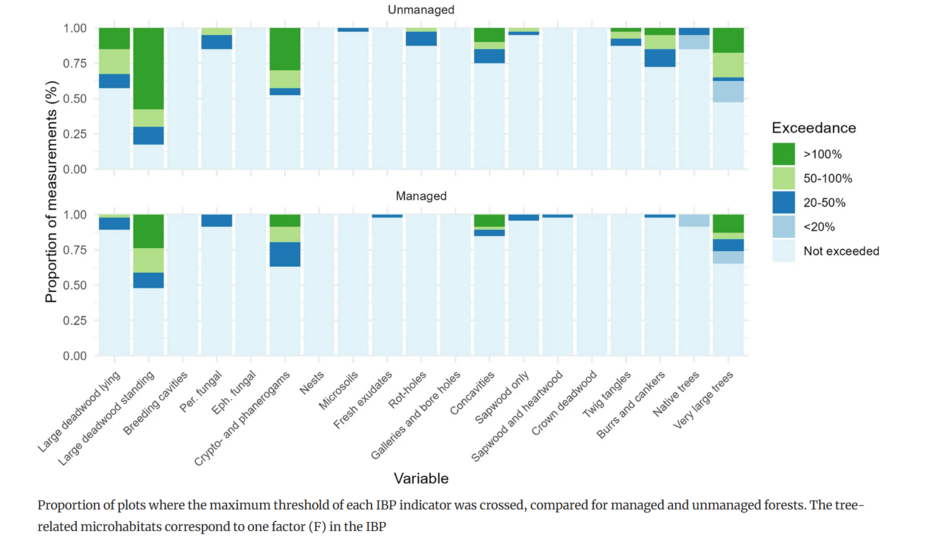
Fig. 4 of the paper: Proportion of plots where the maximum threshold of each IBP indicator was crossed, compared for managed and unmanaged forests. (De Win et al)
- Integrative Forest Management
- Monitoring & Projecting
- Landowners & Practitioners
- Planners & Implementers
- Natural processes and ecosystem preservation
- Specific habitats (deadwood, microhabitats, habitat types,...)
- Structural diversity
- Atlantic
- Belgium
- 2026