

Expansion of Continuous Cover Forestry
Diversification and resilience to biotic and abiotic disturbances, with hydrological co-benefits

Mature stand at QEFP before CCF thinning operations
Continuous Cover Forestry (CCF) is being expanded in Queen Elizabeth Forest Park (QEFP) to increase forest resilience to wind, pests, and climate pressures while maintaining timber production and enhancing public and ecological benefits. Historically dominated by even-aged Sitka spruce, QEFP has transitioned toward structurally diverse, mixed-species stands through long-term thinning programmes. Forest Research and Forestry and Land Scotland have jointly implemented and monitored CCF across more than 150 ha, using field surveys, orthophotos, LiDAR and LAI measurements to guide decisions. Engagement with local communities, practitioners and national agencies has ensured transparency and strong social acceptance in this high-visitation landscape. The approach demonstrates that CCF can deliver ecological, hydrological and visual co-benefits and provides a scalable model for wider adoption across Scotland’s public and private forests.
Context:
Queen Elizabeth Forest Park (QEFP), located within the Loch Lomond and Trossachs National Park, is a large state‑owned forest fully managed by Forestry and Land Scotland (FLS), an agency of the Scottish Government. Historically dominated by even‑aged Sitka spruce plantations, the area has progressively transitioned toward a more multifunctional forest landscape. QEFP is also one of Forest Research’s designated research forests, providing long-term datasets and an established infrastructure for monitoring and experimental work. QEFP was selected as a key site for expanding Continuous Cover Forestry (CCF) because it represents a flagship publicly owned forest with a long tradition of thinning trials, a strong presence of local and national visitors, and a long-standing partnership between FLS and Forest Research across multiple scientific and operational projects.
The ecological context of QEFP is characterised by high exposure to wind, which is a major disturbance driver in Scotland, and by the increasing vulnerability of its forests to pests and diseases—most notably Phytophthora ramorum, which has led to extensive larch removal in recent years. From a social point of view, QEFP plays an important recreational and educational role, welcoming large numbers of visitors each year, with several activities located around The Lodge Visitor Centre. Economically, there is a strong requirement for the forest to continue to deliver timber while moving toward management systems better suited to long‑term resilience and climate adaptation.
Problem Description:
Several stands within QEFP were originally established as uniform, even‑aged conifer plantations. These stands, although productive, were increasingly exposed to windthrow risks and to pest‑ and disease‑related decline. Clearfelling, although operationally efficient, can generate abrupt changes in landscape appearance, reduce habitat continuity, and temporarily alter soil and hydrological conditions. For these reasons, a transition toward CCF was considered beneficial, offering a more gradual approach that helps maintain structural continuity, visual amenity, and ecological functionality.
Implementation Steps:
The transition to CCF at QEFP has been implemented gradually over many years. For the 18 CCF chronosequence stands that FR and FLS established and have been monitoring for the SUPERB project, detailed structural information has been collected with several approaches, including surveys with commercial forest inventory apps, orthophotos, terrestrial LiDAR, and leaf area index (LAI) measurements. Thinning operations have been carried out across approximately 155 hectares since 2000. Manual felling was employed for large trees or trees in challenging locations before further processing by mechanical harvesters. In areas with oversized timber, specialist sawmills were engaged to handle material that could not be processed through standard supply chains. An additional 30 hectares are currently undergoing targeted thinning to complete the conversion trajectory. After each intervention, further orthophoto and LiDAR surveys are collected to document changes in stand structure and to help refine management decisions.
Replicability:
YES, the practice has been tested and replicated in multiple contexts and scales and therefore, can be easily transferred and/or adapted to other initiatives with similar goals.The experience at QEFP shows that CCF can be successfully implemented in Scottish public forests and can be scaled across similar landscapes. FLS has expressed the ambition to extend CCF management to up to 10% of the public forest estate—approximately 47,000 hectares—making QEFP an important reference point for future expansion. The approach is also relevant to private landowners seeking diversified and climate‑resilient forest structures.
Key Success Factors:
Several factors have contributed to the success of the CCF work at QEFP. The long-standing collaboration between Forest Research and FLS has provided a strong evidence base and ensured continuity in monitoring and implementation. Public acceptance has remained high, partly due to the reduced visual impact of CCF compared with clearfell systems and partly because visitors generally perceive mixed‑species, structurally diverse forests as more attractive and interesting than uniform stands. Skilled operators were essential, particularly where large trees required non‑standard felling and processing methods. Finally, the integration of CCF with other restoration actions—including hydrological and biodiversity objectives—helped reinforce the overall value of the intervention.
Common Constraints:
The implementation encountered a number of challenges. The widespread impact of Phytophthora ramorum became an urgent management priority and affected scheduling and availability of resources. High visitor numbers in some parts of QEFP required careful planning to ensure safety during thinning operations. Large-diameter trees presented technical challenges both in felling and extraction. At a broader scale, replicating such work across Scotland may be constrained by market limitations for small volumes of large timber.
Positive Impacts:
- Improved recreational value
- Increased landscape diversity
- Increased structural diversity
- Increased tree species diversity
- Reduced flood risk
The transition to Continuous Cover Forestry (CCF) at Queen Elizabeth Forest Park has generated multiple ecological, social, and hydrological benefits. Thinning operations and long-term structural management have increased stand heterogeneity, promoting a more complex canopy architecture and a more resilient forest structure. These interventions have also diversified tree species composition, creating stands that are better adapted to pests, diseases, and changing climatic conditions. At the landscape level, CCF has enhanced visual diversity by avoiding the abrupt contrasts associated with clearfell systems. This has contributed to improved recreational value in a high-visitation area where forest aesthetics, continuity, and accessibility are important for both local communities and visitors.
Maintaining continuous canopy cover and reducing soil disturbance have delivered hydrological co-benefits, including improved water regulation and reduced flood risk, especially in areas where CCF aligns with ongoing Natural Flood Management and riparian restoration initiatives. Overall, the combination of structural diversification, enhanced visitor experience, and strengthened hydrological function demonstrates how CCF can contribute to a multifunctional and climate-resilient forest landscape.
Negative Impacts:
- Reduced access to markets or income sources
- Reduced timber quality or quantity
In the QEFP case, thinning operations under CCF occasionally produced timber that did not fully match standard market specifications, particularly where large-dimension or irregular stems were involved. Although the total volume extracted during the SUPERB interventions was considerable and a suitable sawmill was successfully identified to process this material, this required bespoke arrangements and additional coordination. These experiences show that, while market solutions can be found, wider upscaling of CCF may require further adaptation within local sawmills and supply chains to accommodate more variable assortments and larger stem sizes. Overall, the negative impacts observed are limited and manageable, but they highlight the importance of continued dialogue between forest managers and processors to ensure long-term operational and economic viability.
Media
-
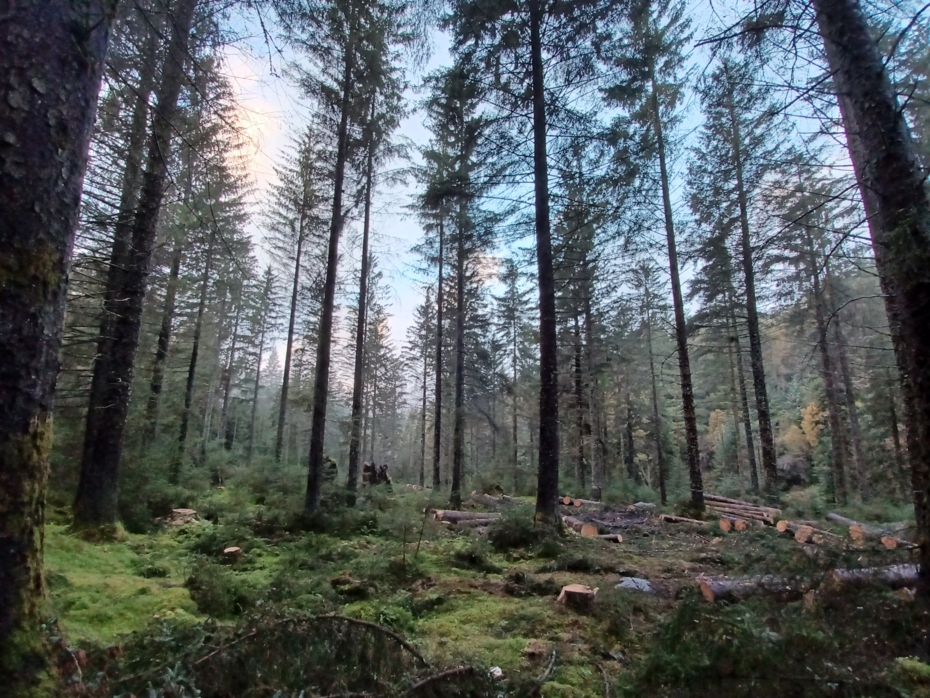
Thinning area in the mature stand at Achray West, Queen Elizabeth Forest Park, UK
- Implementation
- Planning & Upscaling
- Social & Stakeholder
- Landowners & Practitioners
- Planners & Implementers
- Policy Actors
- Climate change mitigation
- Structural diversity
- Tree species/functional diversity
- United Kingdom
- Environmental
- 150