

Fire mimicking measures
Alternative ways to create habitats for fire dependent species

Point burning (localised fire applied under controlled conditions). Photo: Åsa Granberg
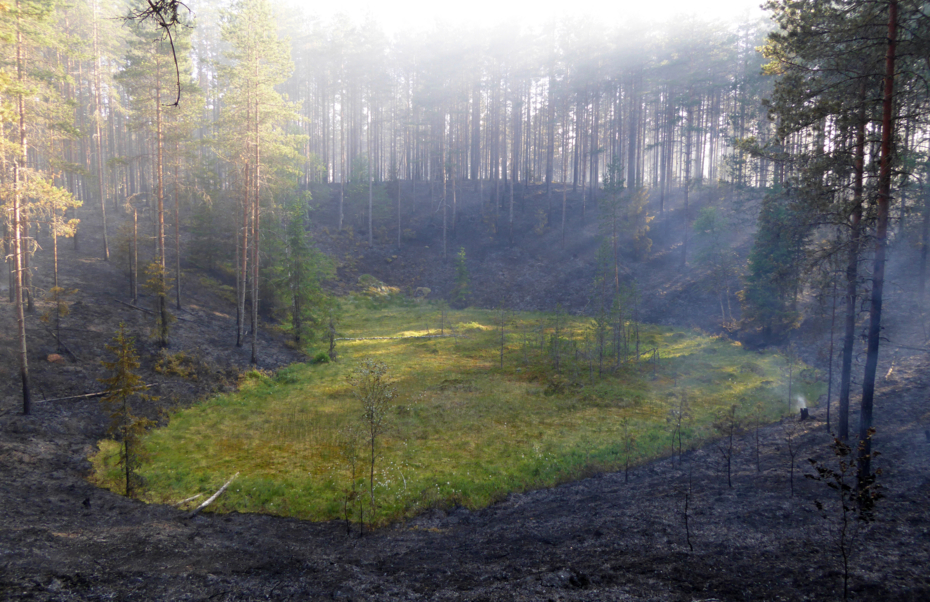
Fire is a natural disturbance in the boreal forest. Today, when wild forest fires are effectively supressed, many species that are dependent on burned forest are threatened. To improve the conditions for these species, conservation burnings might be used. However, conservation burning is not possible everywhere. Instead, fire mimicking measures are often adopted, with the aim of substituting some of the effects of a natural wild fire, such as the development of deadwood in general and in particular so called "Kelo"-trees, i.e. very hard and durable dead pine wood, sparse pine dominated stands or deciduous dominated stands.
Context:
Fire is a natural disturbance in the boreal forest and historically fires shaped the forest landscape, as well as the flora and fauna. Today, when wild forest fires are effectively suppressed, many of the species that are adapted to and dependent on burned forest are threatened. To improve the conditions for these species, both nature conservation authorities and forest companies are doing conservation burnings (a.k.a. prescribed burning or controlled burning). However, conservation burning is not possible in every place needed. In northern Sweden, the reasons for this might be that the area is too important as winter grazing area for reindeers, it is situated too close to inhabited areas, or the terrain makes it too dangerous and difficult to keep the fire under control.
Problem Description:
Forest fires are powerful events with immediate and lasting effects on ecosystems. They kill or damage trees, but species differ in their resilience: Scots pine and Silver birch can often survive, while Norway spruce usually perishes. In dry conditions, this selective mortality creates open forests dominated by fire-adapted species. Some trees endure repeated fires (often >50 years apart), becoming old and resilient to fungi and insects. When they finally die, they persist for centuries as standing or fallen “Kelo-trees,” which provide unique habitats for many species. Fires also disturb the ground, reducing vegetation cover and exposing mineral soil where pioneer trees like Birch, Aspen, and Goat willow establish. These species may also resprout from suckers or stump-shoots, creating a rapid post-fire recovery. In moist areas, this leads to forests dominated by deciduous trees. Without fire, such ecological processes vanish, reducing habitat diversity. To compensate, management practices that mimic fire are sometimes used to recreate these beneficial effects, while avoiding the risks that real fires pose to people and reindeer herding.
Implementation Steps:
Methodological overview
Fire mimicking measures is often used in areas with forest that is prone to fire, but where conservation burning cannot be used for various reasons. They include:
- Veteranisation (different types of mechanical wounding)
- Point burning (localised fire applied under controlled conditions),
- Small-scale ground disturbance to promote establishment of deciduous trees and fruiting of mycorrhiza fungi
- Removal/killing of trees that naturally would have been killed in a forest fire and
- Fencing to promote deciduous trees that form the first forest succession stage after forest fire.
It is often good to combine different fire mimicking measures in an area, since each of the different measures only mimic a small subset of the ecological effects of a natural forest fire. Which measures to choose depends on the specific conditions on the site (which also often vary within the site), as well as opportunity, cost, timing etc. It might also be good to do fire mimicking measures in areas adjacent to where a full scale natural or conservation burning is done, since many fire dependent insects are attracted from far distance by the smell of smoke, and the point burnings that might be done as fire mimicking measures might not be enough to attract these insects.
Start with deciding which area to work in based on field visits and studies of maps and aerial photos. The effects of a forest fires are often patchy, therefore preferably focus each specific measure on patches of 20-30 meter in diameter within the area. To be effective, mark the patches in the field or in your digital field-device beforehand, with clear instructions on what measures to do in each patch. This is especially important if there are several people helping with the actual measures in the field.
If you are hiring contractors to do the actual measures it might be good to both give instructions in the field and to provide some kind of detailed map and written instruction to each type of measure, including a description of the intended result/outcome. By making the contractor understand the purpose of the measures it is easier for him/her to adjust the implementation to changing conditions and to still give you the results you were asking for.
Please observe that local safety regulations and permitting requirements might vary by country and must be checked before implementation!
Veteranisation and point burning
Purpose: to harm but not kill trees in similar way that a forest fire would, i.e. from the ground/base and upwards along the stem, on one side of the tree. Ecological goal: to make the tree produce resin that impregnates the wood, especially at the base of the tree, to create burned wood and deadwood, and to make the tree grow slower.
Equipment (examples): axe, drawknife, chainsaw, harvester, lighter/matches, firewood (or portable campfires), gas burner.
When? Forest fires are naturally reoccurring, in some places as often as every 30 years. To mimic this, it is a good idea to repeat the veteranisation/point burning with an interval of 5-10 years, both on new trees but also on already treated trees, and in that case widen the already existing wound. Naturally, forest fires can occur during spring and summer in the boreal forest, but both veteranisation and point burning might be done any time of year. However, veteranisation is most easily done during early spring when the sap is rising while point burning is often done in late winter/early spring, when there is still some snow left or at least when the ground is wet, to prevent the fire from spreading. Doing the point burning on snow cover also allows for efficient implementation since the firewood/portable campfires can be distributed among trees with snowmobile and skis. And once ignited, one person can handle a large number of fires at the same time since the risk for spreading is minimal.
How to do: Veteranisation ("katning" in Swedish) are done by peeling off 20-75% of the bark from pine trees all the way into the sapwood, from the base up to 0,75-2 m height. To ensure survival it is important to leave a string of unharmed bark, at least 20% wide, connecting the roots to the upper part of the bark. Also, other fire adapted tree species can be harmed in the same way. The measure can be done by both handheld equipment such as axe and chainsaw, but also with a harvester. Using harvester is quick but costly and it might be difficult to peel the bark of all the way down to the roots.
Point burning is the burning of individual trees, without affecting more than a small part of the ground. It is mostly done by making a small fire at the base of the single tree, either by bringing external firewood to the area, or by using burnable material from the site. In northern Sweden it has become common to use pre-made “portable campfires”, see picture. Point burning can also be done using a gas burner.
Killing of vulnerable trees
Purpose: To kill trees that would die in a natural forest fire, mainly species that are not fire adapted, but also young individuals of adapted species which also often are killed in fires.
Equipment (examples): Chainsaw, axe, hand-held chainsaw-chain.
How to do: Girdling is a way to make the tree die standing and slowly, similar to what happen after a forest fire. Either remove the bark in an 1-2 dm wide girdle around the tree with axe or chainsaw or make two or more thin, ring formed cuts around the tree with a chainsaw or a hand-held chainsaw chain. The aim is to stop the transport of water and nutrients between the roots and the crown. If doing the thin cuts, it is important to cut deep enough to reach the sapwood all the way around, but not too deep because then the tree breaks easily by the wind. Always make two or more thin ring cuts as the tree sometimes heal parts of the wound. Depending on method the tree dies more or less slowly, therefor it might be good to mix the two methods in the same area/patch.
Cutting a tree straight off kills the tree immediately and creates lying, fresh dead wood. This kind of death is not a typical effect after a forest fire, but more similar to the effect of a storm. Compared to girdling this method is often more time effective but should be used somewhat restrictively if the aim is to mimic the effects of a forest fire.
Creating ground disturbance
Purpose: To reduce or remove the ground vegetation (mainly dwarf shrubs and mosses) and to create patches with bare mineral soil to favour fruiting of mycorrhiza fungi, insects and allow for seed establishment of Aspen and other deciduous trees, as well as pine trees.
Equipment (examples): A rake or similar (e.g. McLeod tool/rakehoe), a bush cutter with a mulcher devise, a quad bike with a dozer blade or an excavator with a flat shovel.
How to do: Simply remove the vegetation down to the mineral soil in patches, 1-10 m2 in size. This measure can be done both in unburned areas, but also as a complement in areas where controlled burning is planned/implemented, but where the intensity of the fire were/are expected to be too low to consume the vegetation and humus all the way down to the mineral soil.
Fencing for deciduous species
Purpose: To create deciduous dominated stands, similar to the first forest succession stage after forest fire, by allowing deciduous trees to grow tall enough to “escape” browsing pressure from moose and other ungulates.
Material: To withstand large animals such as moose all year around, it is important to build robust fences. The nets shall be at least 2 m high with vertical solid wire. Appropriate mech size depends on what animals that should be kept out, where 17x15 cm is enough for moose. The posts shall have a thickness of at least 10 cm and be made of impregnated wood.
How to do: Fence posts should be placed at intervals of no more than 4 m. Fence posts should be driven into the ground to a depth of between 50 and 80 cm. The nets should be attached to the outside of the posts and nailed in place with fence clips with barbs around the top three wires, then on every other wire. All corner posts and other posts in critical locations should be braced/supported with sloping support posts attached to the upper part of the post they are bracing. The enclosure should have an entrance/exit in the form of a lockable gate, ladder construction, or other passage solution that keeps ungulates out.
Knowledge Types:
The use of these methods, in the context of being “fire mimicking” is rather new, and the knowledge of the ecological effects have only recently started to be researched. However, the practical knowledge of the different types of fire mimicking measures goes back longer. "Katning", a Swedish term for the form of fire mimicking veteranisation that is presented here, has been used in older times to make trees produce more tar and stronger and more persistent wood. Fencing to protect certain tree species from browsing is regularly done as a forestry measure and also ground disturbance is done on regular basis in forestry in the form of scarification, although scarification for forestry purposes is done in much larger scale and with less precision, than when done as a fire mimicking measure.
Replicability:
YES, the practice has been tested and replicated in multiple contexts and scales and therefore, can be easily transferred and/or adapted to other initiatives with similar goals.Fire mimicking measures are increasingly used by both nature conservation/managing authorities and forest companies and the methods have been used and are further developed and documented, e.g., in the Life-Taiga and Life2Taiga projects.
Key Success Factors:
Success factor #1
Nature conservation officers that are willing and able to combine good ecological knowledge on fire prone forest ecosystems with innovative practical management.
Success factor #2
Good relations and communication between nature conservation/management officers from authorities, forest companies, consultants, contractors and NGOs and prestige-less meetings within this group to share and discuss different issues on practical conservation management.
Common Constraints:
Risk factor #1: Lack of finances
Drastic cut down in the national budget for management of protected nature have led to less management actions overall, including fire mimicking measures. However, the large EU-financed project LIFE2Taiga that is going on 2022-2028 provides some extra financing for conservation burnings and fire mimicking measures to many of the Swedish counties.
Risk factor #2: Lack of skilled contractors
Today it might be hard to find good contractors. However, more and more of the traditional forestry contractors learn how to do the fire mimicking measures and also gain a basic understanding of the ecological reasoning behind the measures, leading to better results and more independent contractors.
Risk factor #3: Lack of specialized machinery
Several of the fire mimicking measures can be done time effectively using a harvester. However, the conventional harvester head is not adapted to doing for example veteranisation measures, leading to that the results are not as good as if done by axe or chain saw. A few harvester contractors that are a bit specialized on nature conservation assignments have tested to attach an extra blade on the cutter head to get a better result, but this needs to be further tested.
Positive Impacts:
- Increased (high-quality) lying deadwood
- Increased (high-quality) standing deadwood
- Increased diversity of habitats including micro-habitats
- Increased old-growth attributes, e.g. veteran trees
- Increased structural diversity
As fire mimicking measures aims at creating specific desired structures, such as standing deadwood, burned and/or harmed, but still living trees, bare mineral soil and regeneration of deciduous trees, the direct structural effects can often be evaluated immediately, or within a few years after the measures. However, the ecological effects of different fire mimicking measures often take longer time to develop and require more input from experts to be examined. At the moment (2025) the ecological effects have just recently started to be researched.
Negative Impacts:
- Reduced timber quality or quantity
An unavoidable effect of harming or killing trees to create micro-habitat and deadwood is that it reduces timber quality and quantity. However, as these measures are normally done in forests that are set aside from timber production, this is rarely a problem.
Media
-
-
-
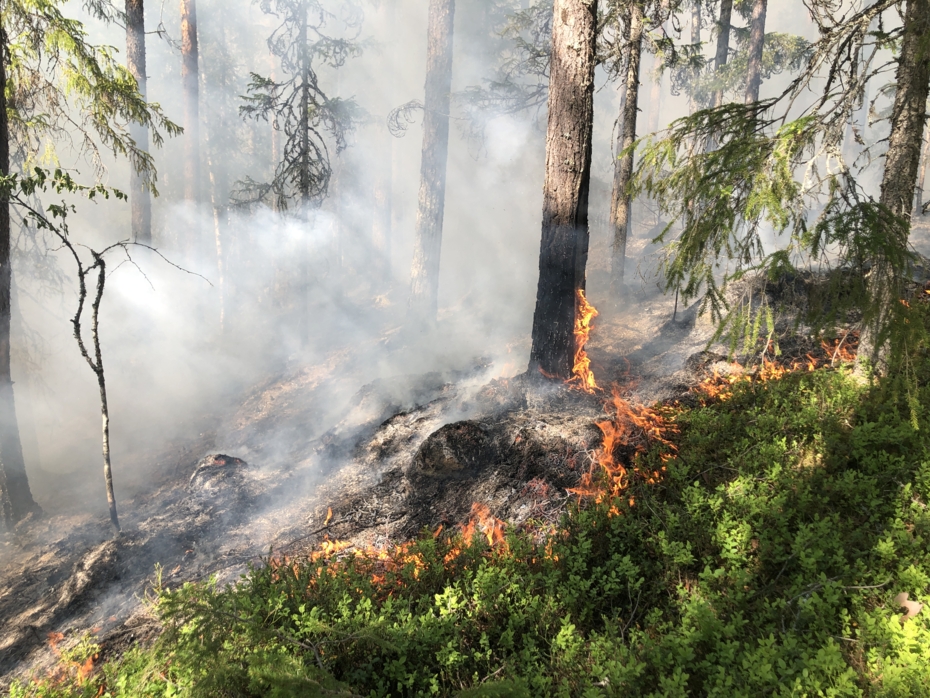
Fire is natural in boreal forests and many species are dependent on burned forests. Today conservation burnings are used to promote these species in the forest landscape. Photo: Åsa Granberg -
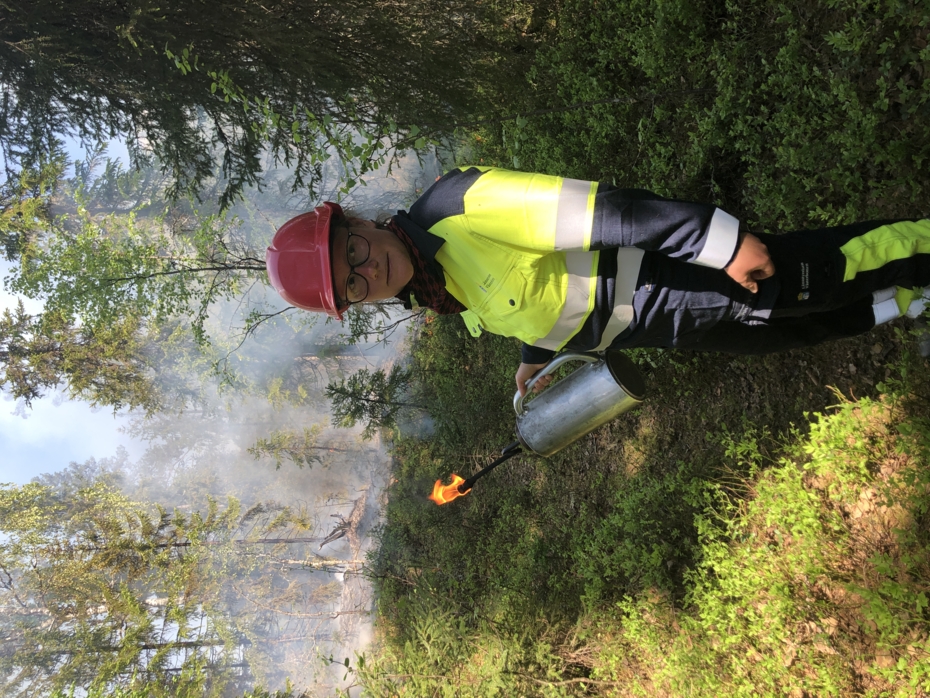
Fire is natural in boreal forests and many species are dependent on burned forests. Today conservation burnings are used to promote these species in the forest landscape. Photo: Åsa Granberg -
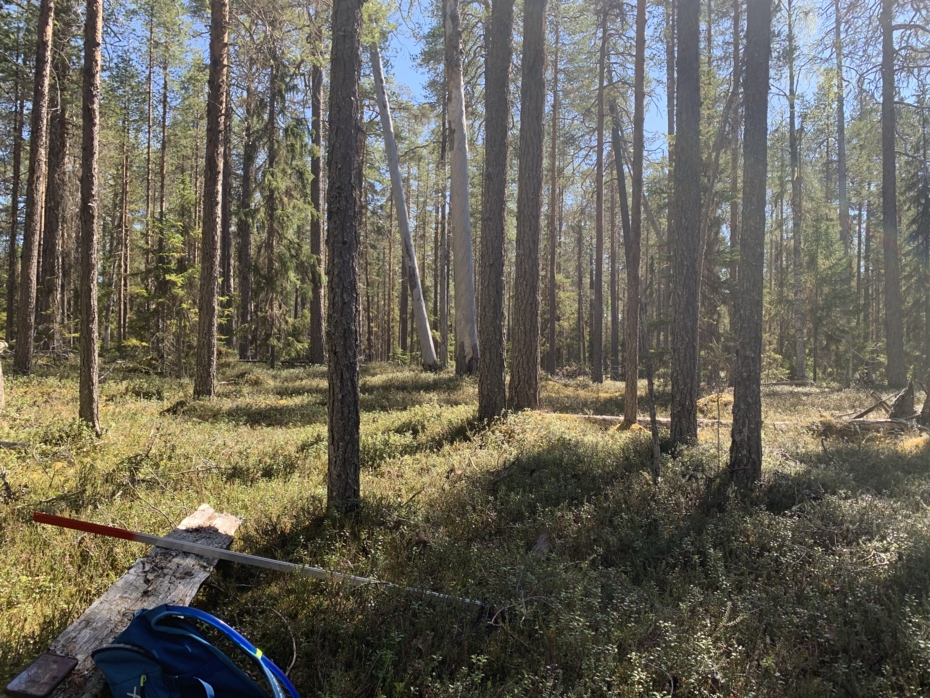
Forest fire creates sparse pine dominated stands, dead wood in general and in particular so called "Kelo"-trees, i.e. very hard and durable dead pine wood (back of the photo). Photo: Åsa Granberg -
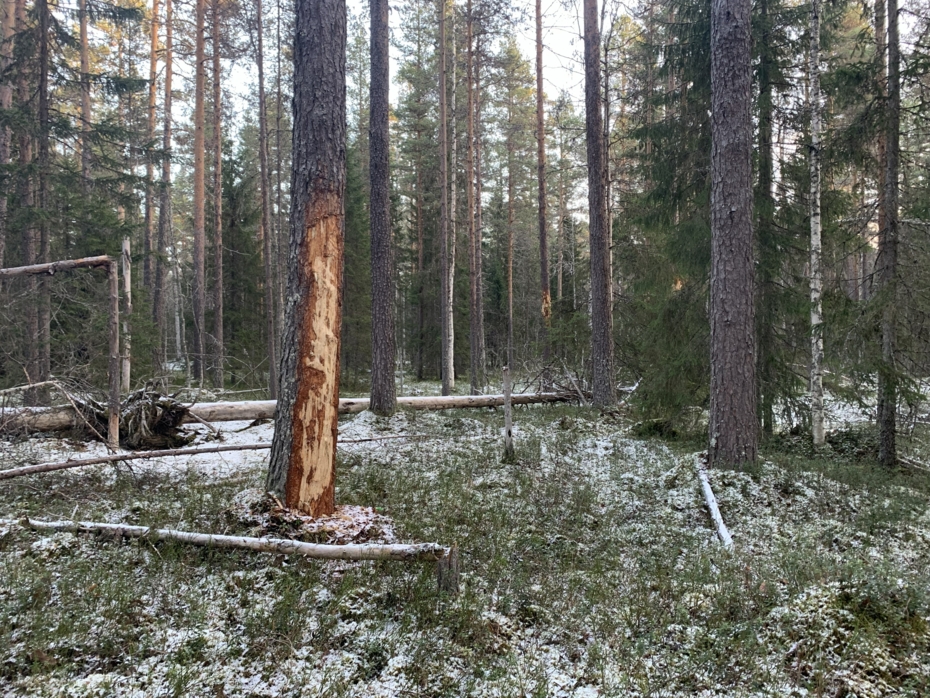
Veteranisation done on pine with a harvester. Photo: Åsa Granberg -
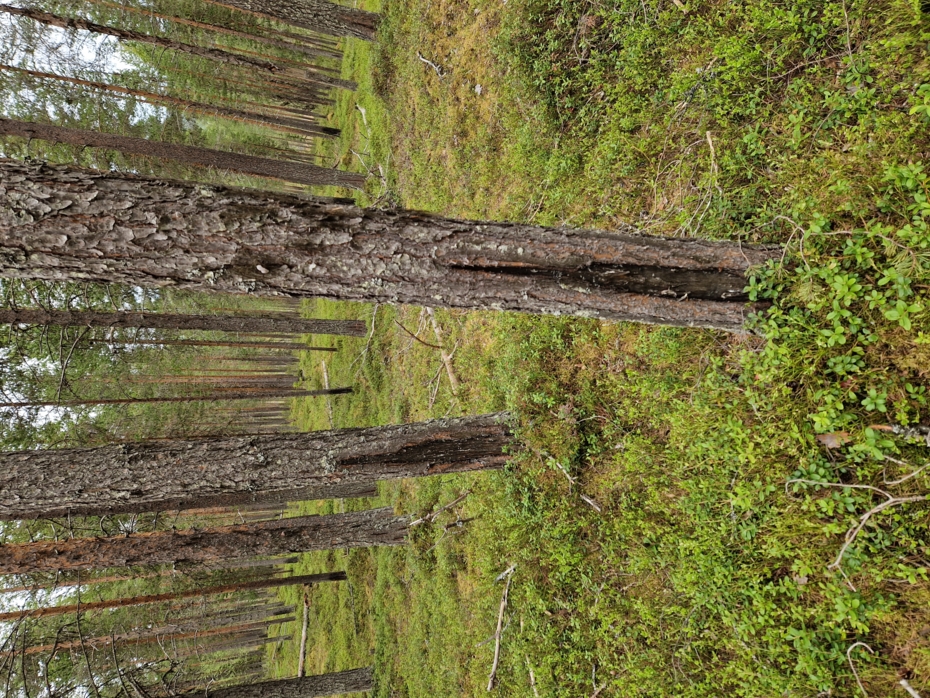
Veteranisation on pine, done with axe, 20 years ago. Photo: Åsa Granberg -
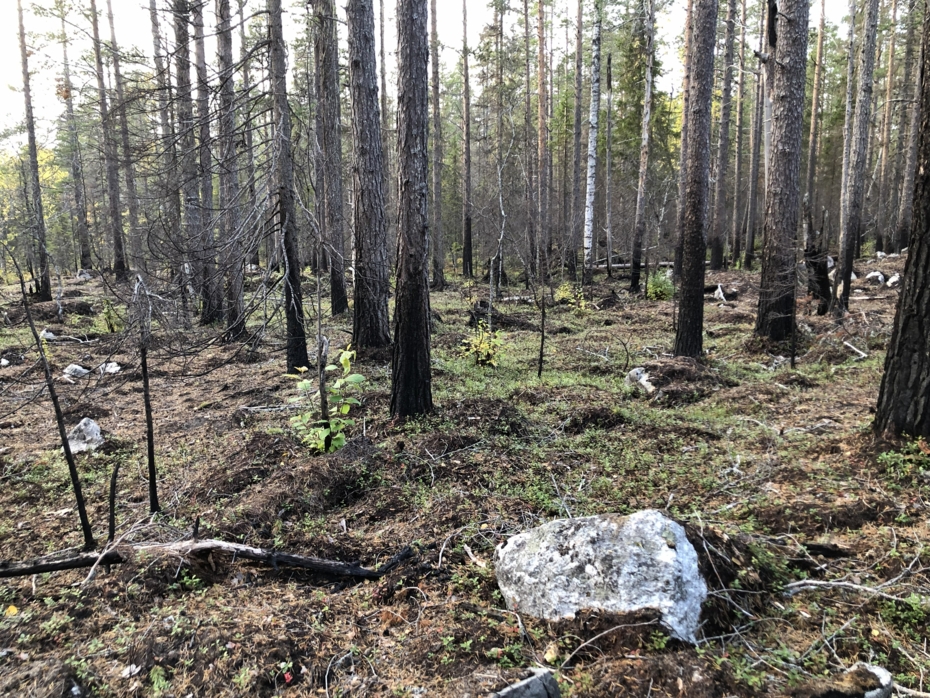
Forest fires normally kill tree species with low resistance to fire, such as spruces. Most deciduous trees also die, but quickly re-colonise by resprouting or seed establishment. Photo: Åsa Granberg -
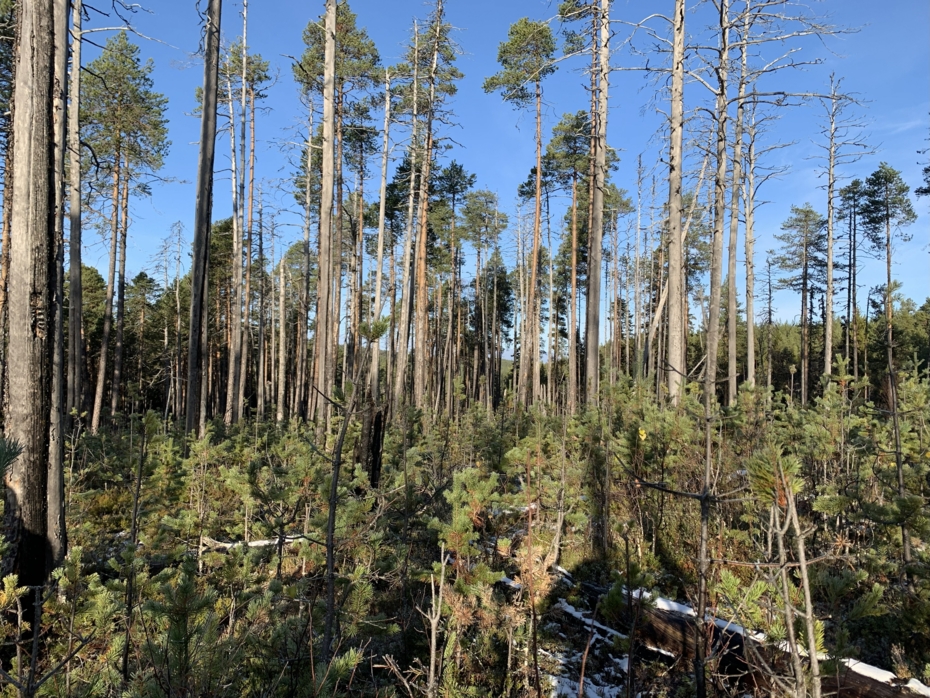
Area that was burned for conservation purpose 30 years ago. Since then, it has been heavily grazed by moose, suppressing regeneration of both pine and deciduous trees. Photo: Åsa Granberg
- Active Restoration
- Implementation
- Integrative Forest Management
- Boreal
- Sweden
- Social
- 3400