

Navigating trade-offs across ownership and ecological priorities in forest conservation planning

forest disturbance in strict forest reserve close to Cologne, Germany
Which forests should be strictly protected to best support biodiversity? A new study from North Rhine–Westphalia explores this question using spatial modelling to compare different conservation pathways for achieving the EU's target of protecting 10% of land. The findings show that different conservation goals lead to very different priorities. While large wilderness areas create more connected landscapes, they do not always protect the greatest diversity of valuable habitats. Involving private forest owners can significantly improve biodiversity outcomes, but requires effective incentives and long-term support. The study demonstrates how systematic conservation planning can help policymakers navigate trade-offs and design protected area networks that are both ecologically effective and socially feasible.
The European Union has committed to placing at least 10% of its land under strict protection by 2030. But deciding which forests should be protected is far from straightforward. Should priority be given to creating large wilderness areas, protecting the rarest habitats, or finding solutions that are also feasible for forest owners?
A new study from North Rhine–Westphalia (NRW), Germany, explores these questions using "systematic conservation planning" – a spatial modelling approach that compares different conservation strategies and identifies where protection would deliver the greatest ecological benefits under real-world constraints.
The researchers developed five scenarios reflecting different policy pathways, forest ownership patterns and conservation priorities. They then evaluated how well each scenario met biodiversity objectives while considering practical factors such as public and private ownership and existing incentive schemes.
The results show that different conservation goals lead to very different maps.
One pathway prioritizes large, connected wilderness areas where natural processes can unfold with minimal human intervention. While this creates more compact protected landscapes, it does not necessarily capture the greatest diversity of valuable forest habitats.
Another pathway focuses on protecting the widest possible range of rare and ecologically important habitats. This approach performs better for biodiversity but depends heavily on the participation of private forest owners.
"How we define conservation success strongly influences where new protected areas should be established," the researchers conclude. "There is no single optimal solution."
The study also highlights the importance of private forests. In NRW, where much of the forest is privately owned, relying on public land alone is unlikely to achieve the EU's conservation ambitions. Expanding protection to include private forests through well-designed incentive schemes could substantially improve the representation of rare habitats – but only if enough landowners choose to participate and long-term funding is available.
The modelling also identified an unexpected opportunity. Forests that have been heavily damaged by drought, storms or bark beetles – often seen as economic losses – could provide cost-effective opportunities to expand strict protection. Allowing these forests to regenerate naturally can support biodiversity while reducing the costs associated with protecting highly productive forests.
Beyond the case study, the research demonstrates how spatial planning tools can support more transparent and evidence-based conservation decisions. Rather than selecting protected areas opportunistically, policymakers can compare alternative strategies, understand the trade-offs they involve and identify solutions that balance biodiversity goals with social and economic realities.
As EU Member States work towards implementing the Biodiversity Strategy for 2030 and the Nature Restoration Regulation, the study provides practical guidance for designing protected area networks that are both ecologically effective and socially feasible.
Ultimately, the research shows that expanding forest protection is about more than meeting numerical targets. It is about making informed choices on where protection can deliver the greatest benefits for biodiversity, climate resilience and future generations.
Media
-
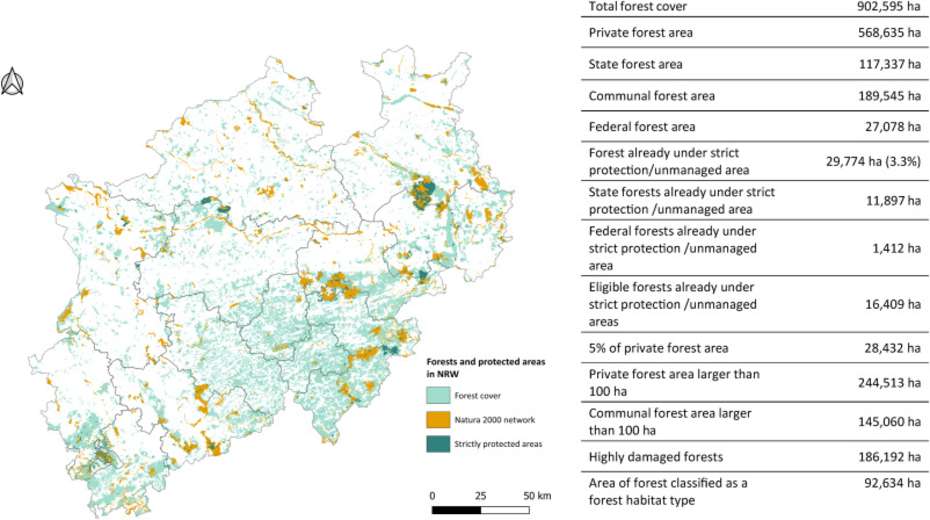
Forests and protected areas in NRW, Germany -
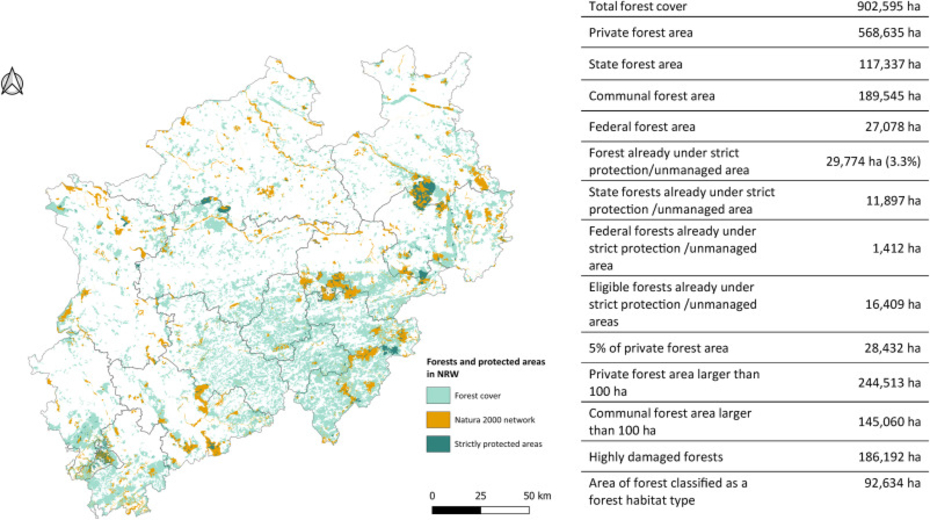
Forests and protected areas in NRW, Germany
- Monitoring & Projecting
- Passive Forest Restoration
- Landowners & Practitioners
- Policy Actors
- Atlantic
- Germany