

Planting in curved lines and orienting shrub facing south

rows spatial distribution
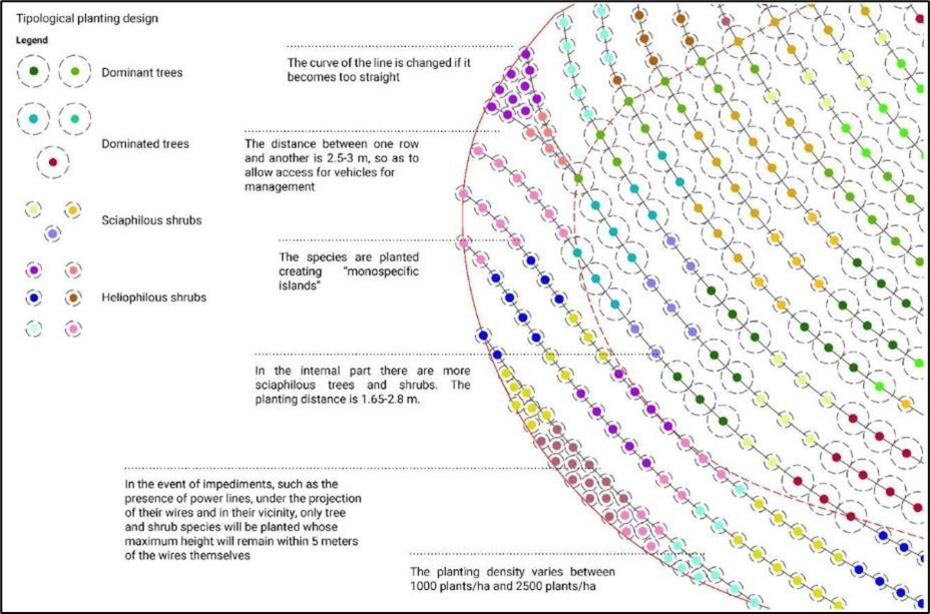
In Urban Forests and general recreation forests, planting in straight lines bring to a “industrial plantation lines” panorama that doesn’t feel natural and hinder the nature contact experience of the users. A simple solution is to plant in curved lines with different species and shrubs clustered in groups: eventual mortality and growth rate differences will evolve the plot into a natural-looking forest
Context:
This planting design allows for better visual approximation to a natural forest. This Good Practice is focused on Urban Forest planting design, or anywhere there is a high need to recreate as much as possible a natural forest, since the objective is aesthetic and recreational. Socio-culturally, that design results in more enjoyable, natural-looking, diverse forests. Ecologically this planting distribution seems to be more friendly or less threatening to fauna (Data and results are work in progress).
Problem Description:
The main problem is the low social acceptance of a forest that is planted in lines. Socially, at least in Italy, is seen as not attractive, and even if, unlike an industrial plantation, it will not be one or two species but at least 15, planting in line is associated with less engagement, more doubts about the real objective of the plantation (someone will think that the trees will be harvested), and general social backlash.
Implementation Steps:
- Decide the species to use and their percentage of population. It is advised to use at least a 25 to 30% of Shrubs species
- Identify the N – S spatial distribution of the plot to plant and create a Shapefile for the planting design
- Leave 3 to 5 m free around ALL plot edges
- In the south edges (depending of local sun exposure, even all band from SW to SE) plan the first one or two curved lines with heliophile shrubs)
- Draw curvilinear, parallel rows depending from desired planted density (Distances between rows are generally 2,5 m, whereas the distance between seedlings along rows are, depending from density chosen, from 1,5 to 3 m)
- Insert the selected species in the design in blotch, so to have 8-10 individuals of the same species close-by
- The planting material is composed of seedlings of 1 to 2 years of age, with certified seed provenance.
Stakeholder Engagement:
Stakeholder engagement was included at the beginning of the practice, by noticing the animosity toward “poplar plantation-like” structured urban parks, in the early 1980’s. After knowing the desired end result (in our case, a recreation forest) the design solution was prepared, shared and discussed by Parco Nord Milano with the community and starting to be implemented By PN in 100 has inside the main Park, and more recently in another at least 60 ha outside the main Park (All in Milan Metropolitan Area, including 11 Ha with SUPERB Project and at least 40 by ForestaMi). Consider that each Urban Forest has a mean size of 1,5 Ha. End users are forest technicians, forest planners and the citizens that will enjoy the area.
Knowledge Types:
Technical knowledge, scientific knowledge
Replicability:
YES, the practice has been tested and replicated in multiple contexts and scales and therefore, can be easily transferred and/or adapted to other initiatives with similar goals.In around 600 has of new Urban Forests planted by Parco Nord Milano in the last 35 years. Will be replicated at every new installation.
Key Success Factors:
No additional cost
Real difference of resulting experience
No meaningful increase of difficulty for the project success
Common Constraints:
Only technical; the design needs to be replicated on the field and it is not always straightforward, but technicians could also be easily trained to maintain curved lines
Lessons Learnt:
Costless Good Practice with high final impact
Heliophiles shrubs fill the area with pollinators, insects and life
Different species growth rate became less visible and natural - looking
Positive Impacts:
- Improved conflict mitigation
- Improved recreational value
- Improved scenic beauty
- Improved societal support
- Increased monetary value of the land/ forest stock
The main impacts were evaluated by citizens and technicians alike, mainly we technicians observed the preference of the citizens and understood that little changes while planting can generate large effects in people acceptance.
Negative Impacts:
- Reduced access to markets or income sources
Could be only the minor increase in planting difficulty and henceforth increased planting initial costs and efforts.
Media
- Active Restoration
- Implementation
- Urban and peri-urban forests
- Landowners & Practitioners
- Planners & Implementers
- Connectivity and landscape diversity
- Other protective and regulatory functions
- Social and cultural values
- Alpine
- Mediterranean
- Italy
- Social
- Applicated and reproduced in close to 600 has of Parco Nord Milano Installations (Milan Metropolitan Area)