

Shaping future forests: how can ecophysiology support climate‐smart forest management?

Forest drought (photo: Adobe stock images)
This paper outlines science-based pathways for climate-smart forestry under rising heat and drought. The review explains how water stress disrupts tree hydraulics, carbon allocation, and ecosystem functioning, increasing dieback risks. It evaluates management levers – species choice, mixtures, thinning, structural diversity, and nutrient management – highlighting trade-offs and the need for adaptive strategies to sustain forest resilience, carbon storage, and multifunctionality in a warming climate.
Forests cover nearly one third of the Earth’s land surface and underpin biodiversity, climate regulation, and human wellbeing. Yet rising temperatures, more frequent “hotter droughts”, and intensifying disturbances are pushing many forest ecosystems beyond their historical limits. A new review, published in New Phytologist, provides a timely and mechanism-based roadmap for climate-smart forest management under these rapidly changing conditions.
The paper synthesises current knowledge on how heat and drought disrupt tree ecophysiology. It explains how water scarcity and high vapour pressure deficits impair hydraulic systems, reduce growth before photosynthesis declines, alter carbon allocation, and increase vulnerability to pests and pathogens. Prolonged stress can lead to hydraulic failure or carbon starvation, ultimately driving forest dieback. At the ecosystem scale, these processes weaken carbon sequestration, alter nutrient cycling, and can even shift forests from carbon sinks to carbon sources during extreme years.
Crucially, the authors move beyond diagnosing the problem. They critically assess how stand-level management can either buffer or exacerbate climate stress. The review evaluates five key levers: tree species selection (including assisted migration), species mixtures, stand density regulation, structural diversification (age, height, layering), and nutrient management. Rather than offering one-size-fits-all solutions, the study highlights trade-offs – for example, between drought resistance and growth efficiency.
A particularly innovative contribution is the integration of “dryland mechanisms” into climate-smart forestry. Traits such as hydraulic redistribution, foliar water uptake, and canopy cooling through convective heat flux – common in arid ecosystems – could be proactively promoted in temperate forests to enhance resilience under future climates.
The authors conclude that uneven-aged, structurally diverse mixed forests, combined with targeted thinning and careful species choice, are likely to offer the greatest resilience to heat and drought. However, they emphasise that long-term experiments and closer collaboration between ecologists and forest managers are essential to test and refine these approaches.
By grounding climate-smart forestry in ecophysiological mechanisms, this paper provides a robust scientific foundation for safeguarding forest multifunctionality.
Media
-
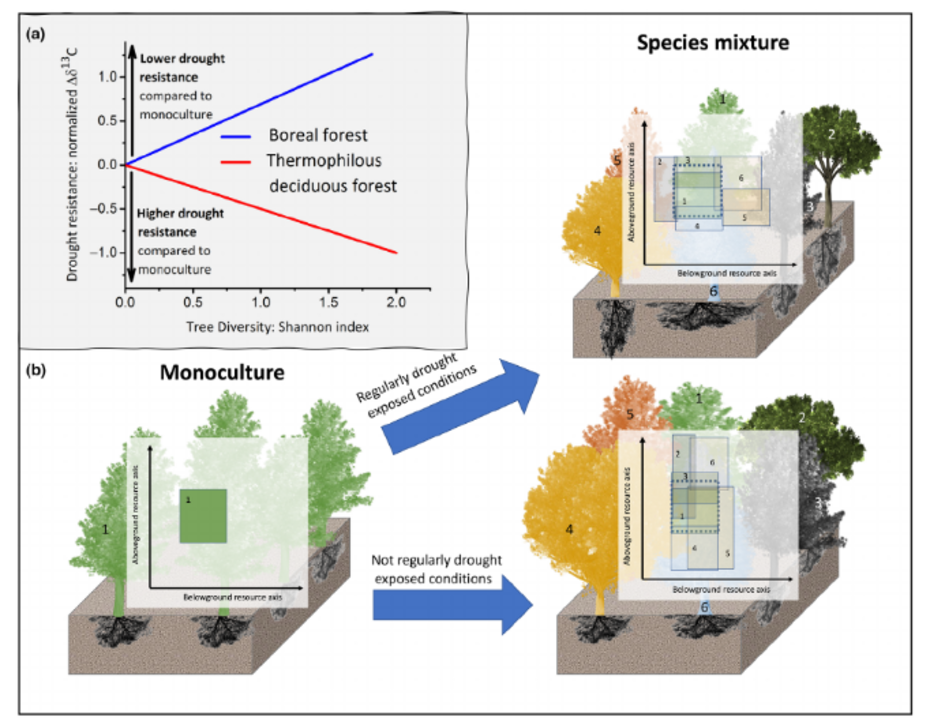
Potential impacts of long-term water-related climatic history on below- and aboveground structure and resource partitioning in species mixtures compared with monocultures.
- Integrative Forest Management
- Monitoring & Projecting
- Landowners & Practitioners
- Planners & Implementers
- Policy Actors
- Climate change mitigation
- Risk mitigation and disturbance prevention
- Tree species/functional diversity