

The meaning of climate-smart forestry – A narrative literature review

Graph illustrating the 3 pillars of "climate-smart forestry"
As climate change influences forests around the world, "climate-smart forestry" has become a popular concept in science and policy. But what does it actually mean?
A new study reviewed a decade of scientific literature and found that there is no single definition. Instead, climate-smart forestry brings together different ways of thinking about forests and climate change. Some approaches focus on storing more carbon, others on making forests more resilient to droughts, storms and pests, while others emphasize innovation, governance and collaboration.
The study also reveals an important gap: while forests are expected to deliver climate, biodiversity and economic benefits at the same time, questions about who makes decisions, who benefits and who bears the costs receive far less attention.
By identifying four recurring ways of understanding climate-smart forestry, the research offers new insights into one of the most influential concepts shaping the future of forest management.
Climate change is transforming forests around the world. More frequent droughts, storms, wildfires and pest outbreaks are making forest management increasingly complex. At the same time, forests are expected to store carbon, support biodiversity, provide timber, protect water resources and sustain rural livelihoods.
Against this backdrop, climate-smart forestry (CSF) has emerged as a widely used concept in science and policy. But what exactly does it mean?
A new study developed as part of the FORWARDS project provides the first systematic analysis of how Climate-Smart Forestry has been interpreted across the scientific literature over the past decade. Reviewing 32 scientific publications published between 2015 and 2025, the research reveals that CSF is not a single, fixed framework. Instead, it is a flexible concept that brings together different perspectives on how forests should contribute to climate action.
Using thematic narrative analysis, the researchers identified four recurring ways of framing CSF. Some publications focus on forests as a key tool for achieving climate mitigation goals through carbon storage and sequestration. Others emphasize building resilient, multifunctional forests that can continue providing a wide range of ecosystem services under changing climatic conditions. A third perspective highlights innovation, technology and improved forest management practices, while a fourth places stronger emphasis on governance, collaboration and the social dimensions of climate action.
Despite these different perspectives, the study found a clear common thread: nearly all interpretations of Climate-Smart Forestry seek to combine climate change mitigation and adaptation. However, the researchers also identified an important gap. While social aspects such as stakeholder participation are increasingly mentioned, much less attention is given to questions of fairness, power and responsibility. Who decides how forests should be managed? Who benefits from climate-oriented forest policies? Who bears the costs and risks of implementation? These questions remain largely underexplored.
The study also highlights that CSF is evolving. Initially centred on climate objectives, the concept is increasingly expanding to include biodiversity conservation and broader sustainability goals. As more objectives are incorporated, understanding potential trade-offs becomes increasingly important. Measures that maximise carbon storage, for example, may not always deliver the best outcomes for biodiversity, timber production or local communities.
By making these underlying narratives explicit, the study offers a new perspective on CSF. Rather than asking which interpretation is "correct", it shows how different understandings shape forest policies, management priorities and future visions for forests.
The authors conclude that CSF can play an important role in responding to climate change – but only if discussions move beyond technical solutions to also consider governance, participation and the diverse values that forests provide. Making these different perspectives visible can support more transparent, inclusive and reflexive forest governance as societies navigate increasingly complex climate challenges.
Media
-
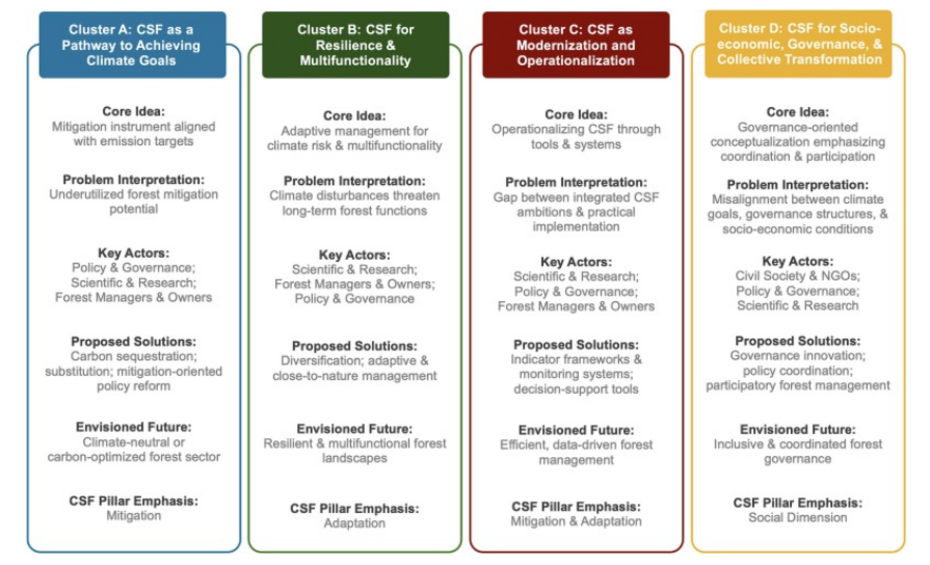
Characteristics of each CSF framing
- Integrative Forest Management
- Social & Stakeholder
- Landowners & Practitioners
- Planners & Implementers
- Policy Actors
- Climate change mitigation
- Social and cultural values
- Structural diversity