

Toward climate-smart rewilding: An integrated framework for biodiversity, climate change, and society

Former agricultural land in Poland (photo by https://pixabay.com/users/arcaion-2057886/)
Climate-smart rewilding could transform how Europe restores nature while tackling climate change. A new study presents a practical framework that brings together biodiversity recovery, carbon storage, climate adaptation and societal benefits, helping policymakers identify where rewilding can deliver the greatest impact. Using Europe as a case study, the researchers highlight opportunities to restore abandoned farmland, create ecological corridors that help wildlife adapt to a warming climate and support rural economies through nature-based tourism. At the same time, the framework explicitly addresses trade-offs, including wildfire risks, competing land uses and potential conflicts between recovering predators and livestock farming. Rather than promoting one-size-fits-all restoration, the approach emphasizes locally tailored solutions that balance ecological, climatic and social priorities. The framework provides a powerful decision-making tool for implementing ambitious biodiversity and climate targets while ensuring that restored ecosystems remain resilient, self-sustaining and beneficial for both people and nature.
A new study – developed as part of the wildE project – proposes a comprehensive framework for climate-smart rewilding, arguing that ecosystem restoration should simultaneously deliver biodiversity recovery, climate mitigation, climate adaptation and societal benefits rather than focusing on a single objective. The approach comes as countries face growing pressure to meet international commitments, including the Kunming-Montreal Global Biodiversity Framework, which calls for restoring at least 30% of degraded ecosystems by 2030, alongside EU restoration legislation and climate targets.
The authors argue that many restoration projects continue to prioritize either carbon sequestration or biodiversity conservation, often creating trade-offs. Carbon-focused interventions, such as monoculture tree plantations, can quickly increase measurable carbon stocks but frequently simplify ecosystems and reduce resilience to disturbances. Biodiversity-focused conservation, meanwhile, may restore habitats without delivering substantial or immediate climate mitigation benefits. The proposed framework instead positions rewilding – the restoration of self-sustaining ecosystems through minimal human intervention – as a way to optimize multiple objectives across landscapes.
At the core of the framework is the restoration of natural ecological processes, including improved habitat connectivity, greater trophic complexity through the return of key species, and more natural disturbance regimes. These processes, the researchers argue, strengthen ecosystem resilience, enhance carbon storage and create wider societal benefits while reducing the need for intensive long-term management.
Using Europe as a case study, the team applied the framework to identify where climate-smart rewilding could generate the greatest synergies – and where trade-offs would require careful planning. Three examples illustrate its practical application.
The first focuses on abandoned farmland as a climate mitigation opportunity. Across Europe, agricultural abandonment is accelerating as rural populations decline and farming becomes less profitable. Around 200,000 square kilometres of EU farmland are projected to face a high risk of abandonment in coming decades, creating significant opportunities for ecological restoration. By combining projections of farmland abandonment with maps of carbon storage potential and ecological integrity, the researchers identified landscapes capable of storing an additional 3.4 petagrams of carbon if rewilded. Major hotspots include the Apennines and Sicily in Italy, the Alps, northern Spain, western Britain and Ireland, as well as parts of Poland, Slovakia, Bulgaria and Romania. However, the study cautions that allowing vegetation to regenerate also increases wildfire risk, particularly in Mediterranean regions, and may facilitate invasive species if left unmanaged. To maximize carbon gains while reducing risks, the authors recommend integrated management measures such as reintroducing large herbivores, maintaining migration routes, applying prescribed low-intensity burns and, where appropriate, using controlled grazing.
A second case study demonstrates how rewilding can strengthen climate adaptation through ecological connectivity. As climate change shifts suitable habitats northwards and to higher elevations, species increasingly depend on connected landscapes to survive. Using climate velocity – a measure of how quickly species must move to keep pace with changing temperatures – the researchers identified northeastern Europe, including Poland, the Baltic States, Finland, Sweden and Ireland, as priority regions for restoring migration corridors. In contrast, mountainous areas such as the Alps, the Balkans and parts of the Iberian Peninsula experience slower climate change and remain important climate refuges. Rewilding abandoned farmland into diverse mosaics of forests, grasslands and shrublands could help reconnect fragmented habitats and facilitate species movement. Nevertheless, the study notes that establishing ecological corridors often competes with agriculture, infrastructure development and other land uses, making locally adapted planning essential.
The framework also explicitly considers social opportunities and risks, an aspect often overlooked in restoration planning. Rewilding can improve water quality, reduce flood and drought impacts, create new recreation opportunities and stimulate rural economies through wildlife tourism. Mapping potential tourism demand alongside the expected return of large mammals, the researchers found the strongest opportunities in central Europe – including southern Germany, Switzerland and Austria – as well as northern Spain, southern France and northern Italy, where recovering wildlife populations coincide with high visitor accessibility.
At the same time, the return of predators presents significant challenges. Areas including northern Spain, Italy, Romania and parts of the Balkans are projected to experience increased conflict between expanding wolf and brown bear populations and livestock farming. Existing measures such as livestock-guarding dogs and improved fencing have reduced predation in some regions but remain context dependent. The authors emphasize that economic benefits from ecotourism should never come at the expense of ecological integrity or local communities, calling for equitable governance and adaptive management.
Overall, the study concludes that climate-smart rewilding provides a practical decision-support framework for identifying restoration strategies that deliver multiple benefits while explicitly acknowledging trade-offs. Rather than prescribing a one-size-fits-all solution, it encourages planners to evaluate biodiversity, carbon storage, climate resilience and socio-economic outcomes together. The authors argue that integrating adaptive management, robust monitoring and standardized ecosystem accounting will be essential for translating the framework into policy and helping Europe meet its biodiversity and climate commitments.
Media
-
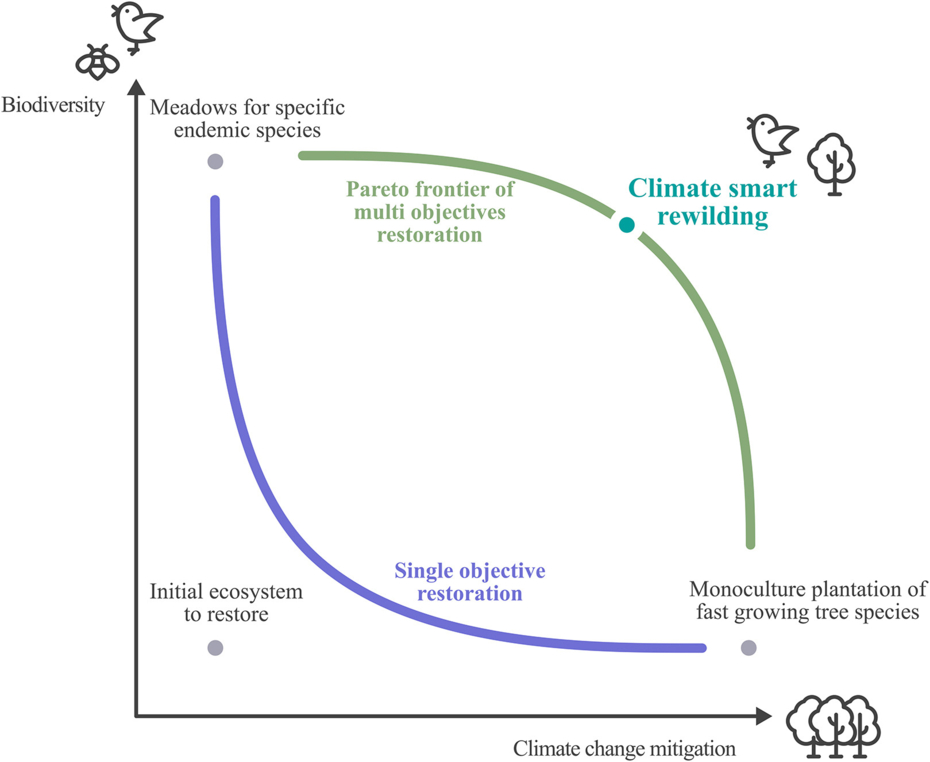
Conceptual representation of single-objective versus multi-objective ecosystem restoration outcomes
- Implementation
- Passive Forest Restoration
- Social & Stakeholder
- Landowners & Practitioners
- Planners & Implementers
- Policy Actors
- Connectivity and landscape diversity
- Natural processes and ecosystem preservation
- Restoration after natural disturbances
- Risk mitigation and disturbance prevention
- Show 1 more