


Landowners / Practitioners
1.4 Restoration goals and methods

When restoring forests, we typically want to recover characteristics and functions that have been lost due to degradation or that the ecosystem can no longer provide in its current state or will have difficulties to provide under future conditions (climate change, new pests and diseases etc.). We need to define restoration goals clearly to determine the most suitable methods and the steps required to achieve them.
Restoration goals can be expressed in terms of the ecosystem’s structure or functions. Examples of such functions include providing habitat for wildlife, improving water quality, storing carbon, or supporting local livelihoods. Usually, the restoration goal is guided by a reference ecosystem or reference model, which represents what the ecosystem might look like if degradation had not occurred in combination with the desired state of the ecosystem considering expectations of the owners and the broader society and what will be possible under climate change. The definition of goals must involve all relevant stakeholders to ensure that restoration efforts remain socially acceptable, ecologically sound, and sustainable in the long term. It is also important to remember that natural ecosystems are dynamic. They continuously change in response to variations in climate, soil, and human activities. Therefore, the reference or target conditions should be regularly reviewed and if needed adjusted as circumstances change.
Once a reference is defined, we need to look for appropriate methods or approaches for approaching the reference. The tools and methods used in forest restoration often come from silviculture, which is the practice of managing forest stands to meet specific ecological and social objectives. Silviculture provides a practical “toolbox” that includes activities such as selecting appropriate tree species, preparing sites, promoting regeneration, selecting, thinning or pruning trees, and managing harvesting. These methods can help guide a degraded forest toward the desired condition. At the same time, silviculture draws on knowledge from other fields, such as ecology, conservation biology, soil science, and climatology, to ensure that practices remain adaptive and effective as scientific knowledge develops and conditions evolve. To support practitioners, a catalogue of restoration practices is available in our Restoration Practices Knowledge Base, which provides examples, lessons learned, and links to additional resources (see more useful materials in the Related Resources section).
Finally, not to forget the monitoring - a critical part of any restoration effort. Regular checks allow us to evaluate whether the implemented measures are leading toward the intended goals. Continuous monitoring and timely adjustments help ensure that restoration interventions remain effective and that the forest moves progressively toward the desired future conditions.
Related resources
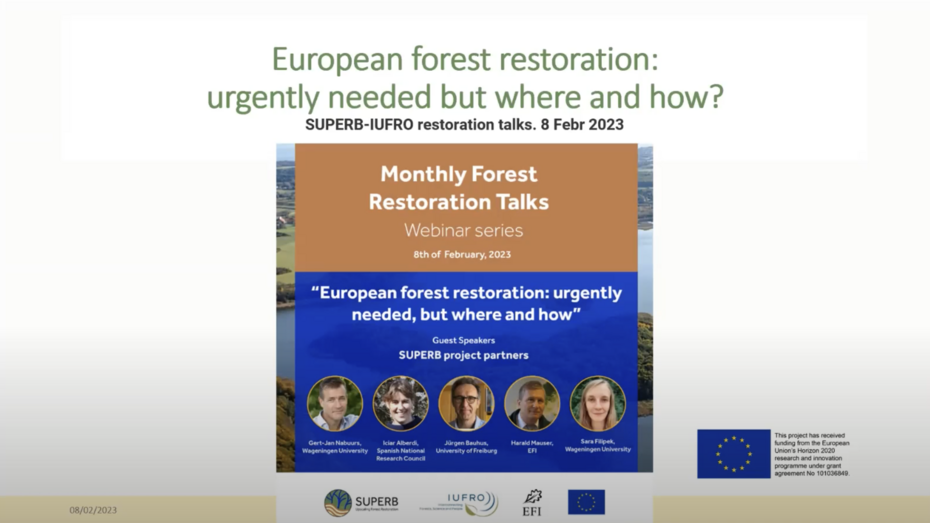
European forest restoration: urgently needed, but where and how?
This webinar, organized by SUPERB and IUFRO, provides a critical view of how habitat status of Europe’s forests is currently assessed and what role data provided by National Forest Inventories can play to inform about forest restoration in Europe. We also take a deep plunge into our SUPERB demo areas and discover the real-life challenges they are facing to implement restoration on the ground.
- Integrative Forest Management
- Legal & Regulatory
- Planning & Upscaling
- Funders & Investors
- Planners & Implementers
- Policy Actors
- Climate change mitigation
- Restoration after direct human impact
- Restoration after natural disturbances
- Soil health
- Tree species/functional diversity
- Atlantic
- Continental
- Croatia
- Finland
- France
- Germany
- Italy
- Netherlands
- Romania
- Serbia
- Spain
Restoration Practices Knowledge Base
Overview of restoration practices and database of different types of resources to support forest restoration practitioners across Europe. It compiles technical guidelines, textbooks and scientific articles and reviews that provide guidance on specific restoration practices.
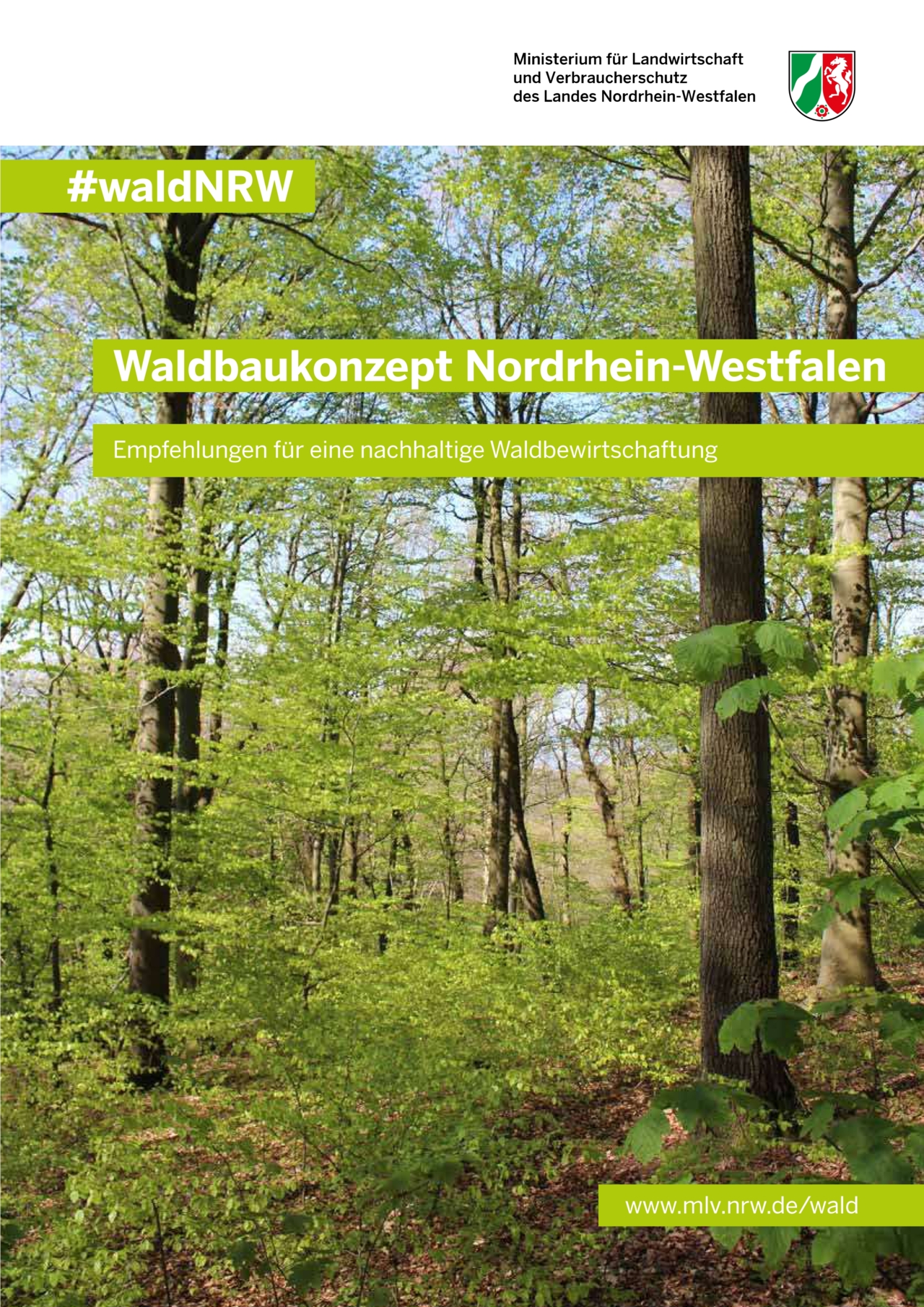
Silviculture Concept of North Rhine-Westphalia, Germany
Climate-adapted forest management requires a rethinking of traditional approaches, with particular attention to climate change-induced shifts in site conditions (i.e, site drift). In this regard, the Waldbaukonzept Nordrhein-Westfalen provides guidance to forest owners and practitioners in establishing and managing resilient, site-adapted mixed-species forest stands.
- Implementation
- Integrative Forest Management
- Planning & Upscaling
- Landowners & Practitioners
- Planners & Implementers
- Policy Actors
- Other protective and regulatory functions
- Risk mitigation and disturbance prevention
- Tree species/functional diversity
- Wood and biomass production
- Atlantic
- Continental
- Germany