


Landowners / Practitioners
2.6 Enhancing soil health

Forest soils serve as the largest terrestrial reservoir of organic carbon, with European soils estimated to store 1.5 to 2.5 times more carbon than the trees above them. Because healthy soils are key to sustaining forests’ many ecological roles, efforts to restore forests must go hand in hand with the restoration of soil health.
Soil health cannot be captured by a single ‘ideal’ condition, as this would differ across ecosystems and land uses. Nevertheless, some indicators remain consistently valuable for evaluating soil health. Effective soil restoration contains three key categories of soil properties, i.e. physical, chemical and biological properties. In the soil chapter of the Restoration Practices Knowledge Base (What to restore?) we propose a set of scalable indicators that can be used in different ecosystems, that are cost-effects and easy to implement. Among the physical properties, bulk density and aggregate stability are the most important indicators to assess. For chemical properties, we recommend measuring pH, soil carbon, soil nitrogen, and electrical conductivity. Assessing biological properties can be time-consuming and costly; to address this, it is suggested to focus on metabolic activity, microbial catabolic activity and diversity, and fine root biomass.
Understanding which soil properties to monitor naturally leads to questions about how restoration techniques can influence these indicators. There are many different forest and soil restoration techniques, each with varying impacts depending on site conditions. The Forest and Soil Restoration Table summarises the short- and long-term effects of these restoration activities on various soil properties. Choosing the right approach requires considering both the previous land use, the current forest type and the soil type.
To understand the impact and success of forest restoration, monitoring is essential. This can include mapping the soil’s capability - its potential to perform certain functions, such as nutrient retention or water regulation - which can be assessed using soil texture, underlying geology, and soil type maps, along with field observations, relevant literature, and high-resolution spatial data. In addition to soil capability, it is important to evaluate soil condition - the physical, chemical, and biological properties that can be managed to improve soil health. Understanding the causes of forest degradation and setting clear restoration targets is also crucial, as this provides a measurable framework for monitoring. Monitoring should take place both before and after restoration, using scalable indicators. Our Guidelines (4. How to monitor?) include a table summarizing these indicators along with their recommended sampling and analysis methods.
Related resources

Restoration Practices Knowledge Base
Overview of restoration practices and database of different types of resources to support forest restoration practitioners across Europe. It compiles technical guidelines, textbooks and scientific articles and reviews that provide guidance on specific restoration practices.
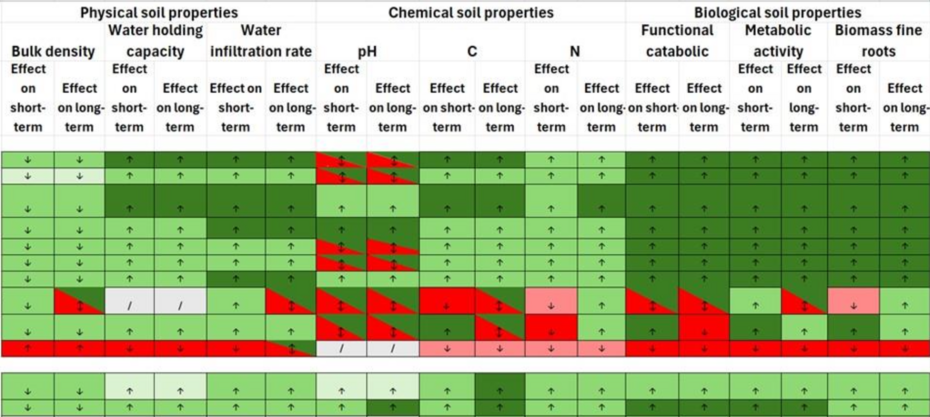
Forest and Soil Restoration Table
An Excel table that outlines various forest restoration measures and their effects on key soil parameters. This table offers a practical overview for assessing the benefits and limitations of different approaches to forest and soil restoration. Colours indicate a positive or negative effect, while the arrows indicate if there is an increase or decrease of the soil properties. When interpreting this table, it is important to consider that factors like previous land use and implementation quality can strongly influence soil recovery outcomes.