

Landowners / Practitioners
2.5 Habitat trees

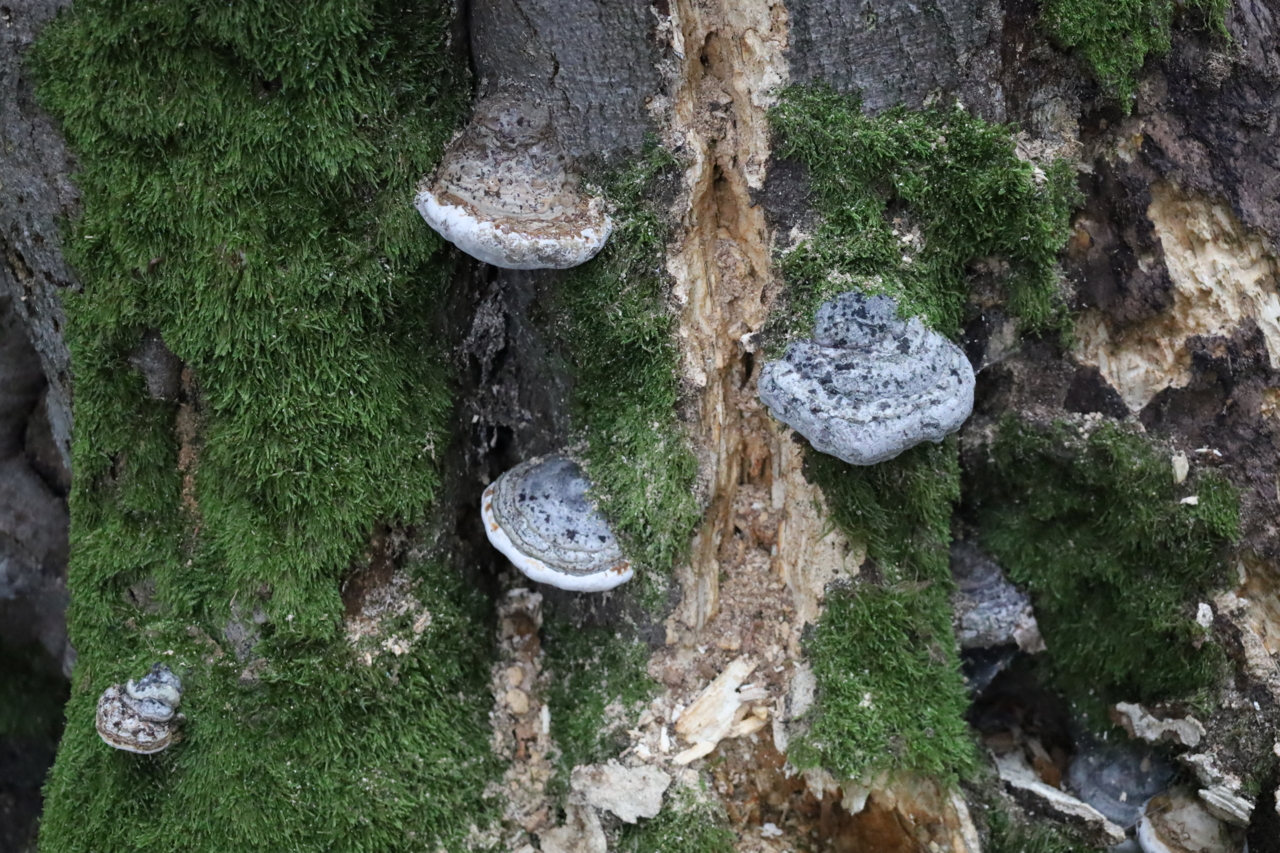
Habitat trees are standing trees, either alive or dead, which display tree microhabitats. Prominent examples of tree microhabitats are cavities and rot holes, tree injuries, cankers, lichens and mosses, fruiting bodies of fungi or crown deadwood. Cavity-bearing trees are among the most important habitat trees for forest wildlife. The abundance and diversity of tree microhabitats strongly increase with tree diameter and bark thickness, and therefore typically with tree age. They may harbour a broad range of species including bats, birds, insects, mammals, molluscs, spiders or amphibians. Especially old cavities with decayed residue can provide a home for several highly threatened forest beetles. However, also smaller trees can fulfil the role of habitat trees depending on the tree species, or the availability of injuries or epiphytic structures.
To enhance biodiversity in managed forest, the designation of habitat trees can become an integral part of forest operations besides measures such as deadwood accumulation. There are no prescriptions provided but it is recommended to retain five to ten habitat trees per hectare. Habitat trees that are selected, and properly marked, should display microhabitats, or they can also be low quality trees that would be usually removed during a thinning. In the case there are no proper habitat trees, so called “candidate” trees can be designated. At each tree marking visit especially the “candidate” habitat trees should be checked if they still apply or if there are other better candidates. Any new habitat tree, e.g. a tree with a broken top or injury should be added as an addition. The distribution of habitat trees can follow different approaches, either evenly distributed, aggregated or best both combined over a larger forest area.
The designation of habitat trees across forest management units is best combined with other protection measures. Such are strict protected forest reserves and stepping stone habitats (smaller set-asides with longer habitat histories) which can serve as donor areas for temporal colonisation of habitat structures and deadwood. Through the combination of such elements, species which have a limited dispersal potential or lack special structures will be better able to spread and establish temporarily also in managed forests. Thus, habitat trees are one important element for considerably improving the quality biodiversity matrix in managed forests.
Related resources
Restoration Practices Knowledge Base
Overview of restoration practices and database of different types of resources to support forest restoration practitioners across Europe. It compiles technical guidelines, textbooks and scientific articles and reviews that provide guidance on specific restoration practices.
Integrative approaches as an opportunity for the conservation of forest biodiversity
The Integrate project final report by the European Forest Institute’s Central European Office presents research on integrating biodiversity conservation into forest management. It analyzes forestry impacts, trade-offs, and multifunctional forests, offering cross-border scientific and practitioner insights to support informed policy and practical decisions in Central Europe.
Tree related microhabitats in temperate and Mediterranean European forests: A hierarchical typology for inventory standardization
A harmonized framework defining and classifying tree-related microhabitats (TreMs) – from cavities to fungi – to make forest biodiversity monitoring more consistent, comparable, and practical across Europe.
The stepping stone concept: Nature-conservation-oriented Integrative Forest Management protects the diversity of forest species
The book "Das Trittsteinkonzept" describes different elements of nature-protection in managed forests. The most important element is the habitat-tree. That can be a single habitat-tree or a group of them (Waldtrittsteine or stepping stones).